
The types of wigs are best sorted three ways: by cap construction (capless, monofilament, hand-tied, lace front, full lace), by base material for hair systems (lace, polyurethane skin, monofilament, hybrid), and by fibre (human hair or synthetic). The base sets the attachment method.
This guide defines each type and maps every base to the attachment a manufacturer publishes for it. It’s written for the studios, stylists, barbers and distributors who fit and supply wigs and hair systems, with notes on prep, adhesive, maintenance and the client in your chair. More guides like this are on the Professional Hair Labs blog.
Types of wigs at a glance
- Cap construction is how the hair is fixed to the cap: sewn in machine-made wefts, or knotted by hand into mesh or lace.
- A lace front is a feature added to a cap, so a monofilament or hand-tied wig can also have a lace front.
- Hair system bases come in lace, polyurethane (skin), monofilament and hybrids. One manufacturer lists skin bases at 0.03 mm, 0.06 mm and 0.08 mm thick.
- One manufacturer’s 2026 guide lists tape or liquid adhesive for skin and lace bases, and usually tape for mono. Clips, combs and bands secure units without either.
- Human hair can be heat styled like natural hair. Standard synthetic fibre can’t, and heat-friendly synthetic has a published limit of 275°F (135°C).
In this guide
- What are the different types of wigs?
- Types of wigs and their names, by cap construction
- Hair system base materials
- Wig hair types: human hair, Remy and synthetic
- Wig and hair system attachment methods
- Base-to-attachment map for fitters
- Types of wigs for men: hair systems
- Choosing a GHOSTBOND adhesive by conditions and wear pattern
- Stocking wigs and hair system supplies
- FAQ
What are the different types of wigs?
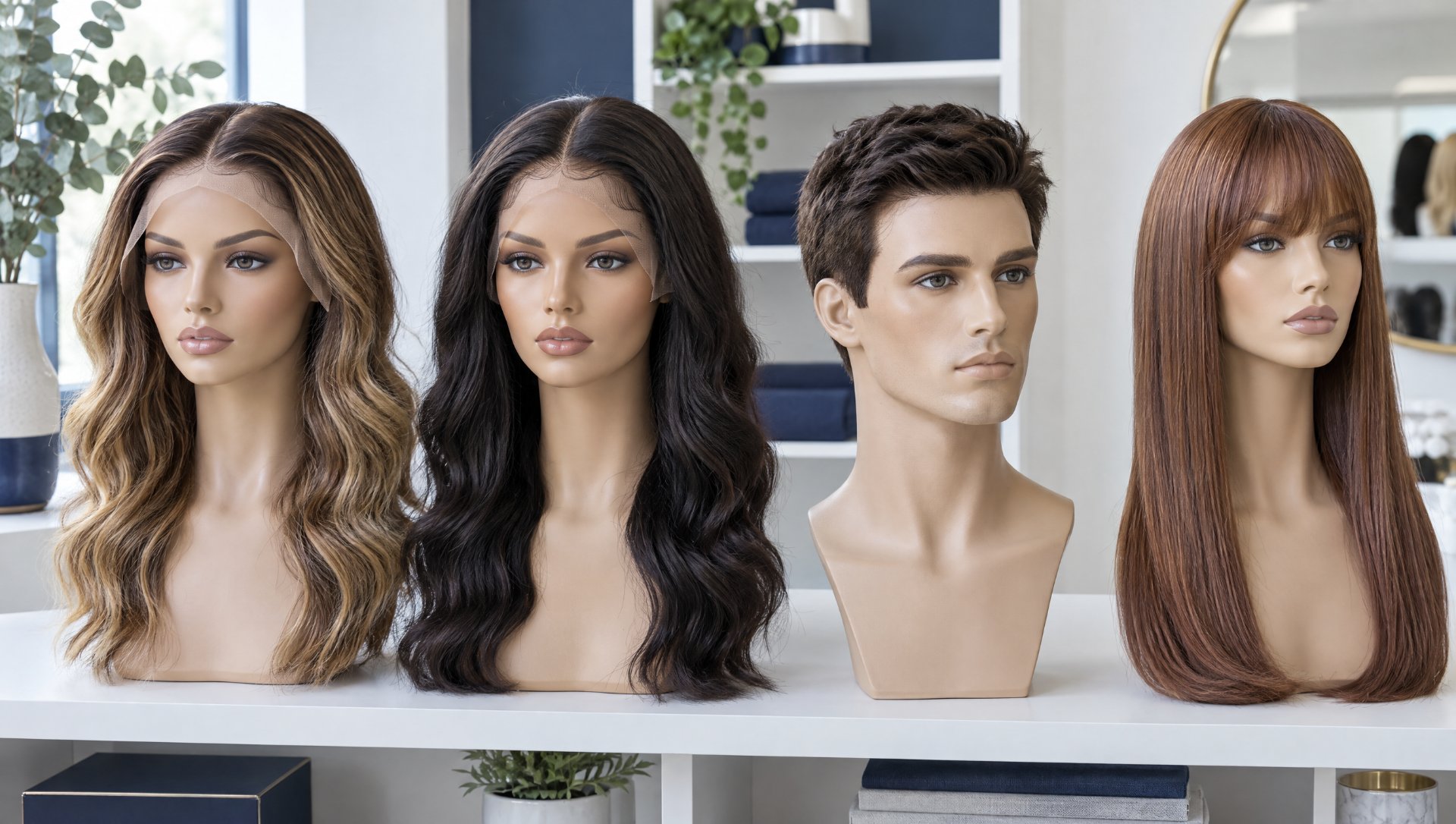
The main types of wigs are named after how the cap is built: capless (wefted), monofilament, hand-tied, lace front, full lace and 360 lace, plus closure, frontal and U-part units. Hair systems, the partial units covered in the men’s section, are named after their base instead.
The fibre (human hair, Remy human hair, synthetic, heat-friendly synthetic or a blend) and the attachment method add further labels. One unit can have several names at once, such as a “monofilament lace front human hair wig”.
Types of wigs and their names, by cap construction
Definitions come from the wig retailer and trade guides listed in the sources.
| Cap type | Hair attachment | Parting | What it means for the fitter |
|---|---|---|---|
| Capless (wefted, open cap) | Machine-sewn wefts in rows, with open spaces between | Pre-styled, fixed | Light and cool, with built-in volume |
| Monofilament | Each hair hand-tied to sheer mesh (part, crown or full top) | Fixed on a mono part, free on a full mono top | Part flexibility depends on mono size |
| Double monofilament | Mono top with a second soft mesh layer under the knots | As a mono top | The second layer protects the scalp from the knots |
| Hand-tied | Top plus sides and back knotted by hand | Not stated by source | Soft, stretchy cap. Can feel warmer |
| Lace front | Hand-tied sheer lace panel at the hairline, on any cap | Off-the-face styling | Lace needs careful handling |
| Full lace | Whole base made of lace, hair knotted in individually | Not stated by source | Glued down or sewn in by a stylist |
| 360 lace | Lace around the whole perimeter, cap in the middle | Not stated by source | Lace edge all the way round |
| Closure unit | Small lace square, 4×4 or 5×5 inches | Middle or side part | Lower maintenance than a frontal |
| Frontal unit | Ear-to-ear lace strip, roughly 13×4 inches | Part anywhere | Allows ponytails and half-ups. Needs regular edge care |
| U-part | U-shaped opening where the wearer’s own hair is left out | Wearer’s own hair | Combs or sewn in |
| Skin top or silk top | Hair implanted into a thin artificial scalp (skin) or set under layers of silk (silk) | Typically fixed on a skin top | Silk hides the knots. A clear PU skin top shows them |
Capless (wefted) wig
A capless wig is built from wefts, curtains of hair machine-sewn in rows onto thin elastic strips. Headcovers notes that “a capless wig has a cap”, with open spaces between the wefts for airflow, and the style and part are set at the factory.
Monofilament wig
A monofilament wig has a top of sheer polyester or nylon mesh, with each hair knotted into it by hand so the scalp shows through. On a full mono top the hair can be parted anywhere. On a mono part or mono crown, the part is fixed (Headcovers). A double monofilament cap adds a second soft mesh layer under the knots.
Hand-tied wig
A hand-tied wig has every hair knotted individually into a mesh cap, top, sides and back, with no wefts or seams. Headcovers says the mesh “conforms to your head rather than gripping it”. Simply Wigs says one can take up to three days to make.
Lace front, full lace and 360 lace wigs
A lace front is a sheer lace panel at the hairline, each hair hand-tied so the edge blends with the skin. Headcovers describes it as a feature that can be added to any cap. A full lace wig’s base is lace throughout. A 360 lace wig has lace around the whole perimeter and cap in the middle (Mayvenn).
Closures and frontals (4×4, 5×5, 13×4)
A closure is a small square of lace, 4×4 inches (10.2 x 10.2 cm) or 5×5 inches (12.7 x 12.7 cm), that allows a middle or side part. Mayvenn describes a frontal as an ear-to-ear strip of “roughly 13×4 inches” (about 33.0 x 10.2 cm) that “runs about four inches back”. A frontal can be parted anywhere and worn in a ponytail. It needs regular edge maintenance, while a closure is lower maintenance.
U-part wig
A U-part wig has a U-shaped opening so a large section of the wearer’s own hair can be left out and blended over the unit. Behindthechair.com says these are secured with combs or sewn in with needle and thread.
Skin top and silk top wigs
A skin top (polyurethane top) wig has hairs implanted into a thin artificial scalp, and Headcovers says the part is typically fixed. A silk top hides the knots under layers of non-transparent silk. Hairalicious notes that some makers use the two terms for the same thing, so check the spec sheet.
Hair system base materials
A hair system is “hair attached to a thin base that is fitted over an area of hair loss and integrated with the wearer’s remaining hair”, in the words of the American Hair Loss Association (AHLA). The base material sets the look, the breathability, the attachment and how long the unit lasts.
| Base | What it is | Thickness (where published) | Lifespan published by New Times Hair (2026) |
|---|---|---|---|
| Polyurethane (skin, PU, poly) | A thin skin-like film | About 0.02 to 0.04 mm for ultra-thin (AHLA). 0.03, 0.06 or 0.08 mm (New Times Hair) | 0.02 to 0.03 mm: around 3 to 6 weeks. 0.04 to 0.06 mm: around 2 to 3 months. 0.08 mm and up: around 3 to 6 months |
| French lace | Open lace mesh, thin and light | Not published | Around 3 to 6 months (French and Flex lace) |
| Swiss lace | Finer, more fragile lace | Not published | Around 2 to 3 months |
| Monofilament (mono) | Stronger woven mesh | Not published | Around 6 to 12 months |
| Hybrid | Mixed zones, such as lace at the front, PU around the sides and back, mono through the centre | Varies by zone | Around 3 to 12 months |
These lifespans are one manufacturer’s guide. The AHLA says there’s no universal figure, as lifespan depends on base construction, thickness, ventilation, hair quality and maintenance. The AHLA puts ultra-thin at about 0.02 to 0.04 mm, and New Times Hair’s lifespan bands put it at 0.02 to 0.03 mm.
Polyurethane (skin) base
New Times Hair lists polyurethane bases at 0.03 mm, 0.06 mm and 0.08 mm, with 0.06 mm the most popular, and the AHLA calls 0.03 mm a common ultra-thin spec. In New Times Hair’s figures, thinner bases wear out sooner. The same maker notes skin bases are “not particularly breathable”.
French lace and Swiss lace bases
Lace bases are open mesh, which the AHLA says “allows more airflow through the base”. New Times Hair describes French lace as “thin, light and natural”, taking up to medium-heavy density. Swiss lace is thinner and more natural looking, but “very fragile and tears easily”, takes single split knots only and suits medium-light density.
Monofilament base
A mono base is a stronger woven mesh, chosen when durability matters. New Times Hair describes fine welded mono as fine, natural and breathable, and thicker and more durable than French lace, taking up to extra-heavy density. Fine mono needs its edges sealed with skin or ribbon. Residue can embed in the tight weave, so cleaning a mono base is more involved.
Hybrid base
A hybrid base combines materials in zones. New Times Hair’s example uses lace at the front for the hairline, PU around the sides and back for attachment, and mono through the centre for structure.
Wig hair types: human hair, Remy and synthetic
The fibre sets the styling options and the lifespan. Breastcancer.org publishes these typical lifespans.
| Fibre | Heat styling | Typical lifespan (Breastcancer.org) |
|---|---|---|
| Standard synthetic | No heat tools | 4 to 6 months |
| Heat-friendly synthetic | Low settings, below 275°F (135°C) | 2 to 3 months |
| Blend (human hair and heat-friendly synthetic) | Not stated by source | 6 to 12 months |
| Human hair | Styled like natural hair | 1 year or more |
Human hair and Remy hair
Human hair gives “the most natural look and movement” of any wig fibre, according to Breastcancer.org, and can be styled like natural hair, but it needs more upkeep. “Remy” is a trade term, and we didn’t find a legal or standards definition. Wig retailers such as Simply Wigs and Wig Studio 1 define it as human hair with the cuticles intact and aligned in one direction. Wig Studio 1 explains that non-Remy hair comes from mixed sources, can’t guarantee cuticle direction, and is treated to partly remove the cuticle. Done badly, that treatment can cause “matting and inversion”.
Synthetic and heat-friendly fibre
Synthetic fibre is man-made, from materials such as plastic or acrylic. It holds its set style through washing, but standard grades can’t be dyed or heat styled. Heat-friendly fibre takes low heat. Wigs.com and Breastcancer.org both give 275°F (135°C) as the limit. Alopecia UK calls these “high heat” or “Cyber” fibres. For care routines, see our synthetic wig care guide.
Wig and hair system attachment methods
Wigs and hair systems are attached with liquid adhesive, double-sided tape, clips, combs, or bands and straps. Some units are sewn in by a stylist instead.
- Liquid adhesive. A clear or white liquid brushed on the skin, in solvent-based or water-based formulas (New Times Hair). Alopecia UK says glue can last up to 6 weeks and is for hairless areas only. It also advises a skin allergy test.
- Tape. Double-sided adhesive on a carrier, in rolls, contour shapes or mini tabs. Alopecia UK gives up to 4 weeks, but advises changing it weekly. It’s for hairless areas only.
- Clips. Small clips anchor the unit into the wearer’s own hair. The AHLA notes that smaller partial units and systems using clips can sometimes be worn without shaving the whole area. New Times Hair says clips are a rare request for men’s systems.
- Combs. Combs grip the wearer’s own hair. Behindthechair.com lists combs as one way to secure a U-part.
- Bands, straps and grips. Milk & Honey Wigs lists built-in adjustable straps, an elastic band sewn inside the cap, a wig grip band worn underneath, and a wig cap for extra grip.
- Sewn in. A stylist stitches the unit into place, as with some lace wigs and U-parts.
The AHLA says modern hair systems can be attached using “tape, liquid adhesive or combinations of both”. For a bonded system, it says “the natural hair within the attachment area is shaved or clipped extremely short so tape or liquid adhesive can bond directly to the scalp”.
Base-to-attachment map for fitters
This table maps each base to the attachment one manufacturer, New Times Hair, publishes for each base in its 2026 guide. The “Typical client” column is New Times Hair’s base-choice profile, not a GHOSTBOND recommendation. The adhesive approach follows the method on the GHOSTBOND product pages.
| Base or unit | Usual attachment | Prep and adhesive approach | Maintenance notes | Typical client |
|---|---|---|---|---|
| Polyurethane (skin) | “Full adhesive or tape” | Clean, prepped scalp. With GHOSTBOND, a thin coat on the base first, then 4 thin coats on the scalp | Easy to clean. The thinnest bases wear fastest | Clients after “scalp effect and easy cleanup” |
| French lace | “Tape or liquid adhesive” | Clean, prepped scalp. With GHOSTBOND, skip the base coat and apply the 4 coats to the scalp only | Lace needs careful handling (Breastcancer.org) | “Active clients, warm climates, exposed hairlines” |
| Swiss lace | “Tape or liquid adhesive” | As French lace | The most fragile base. “Tears easily” (New Times Hair, 2019) | As French lace, at medium-light density |
| Monofilament | “Usually tape, often with a PU perimeter” | Tape, often on a PU perimeter (New Times Hair) | Residue embeds in the weave, so cleaning is more involved | “Clients wanting fuller density and a stronger base” |
| Hybrid | “Attachment can be matched to different base zones” | As each zone’s material | Clean each zone as its material needs | “Clients who need several benefits in one system” |
| Clip-on partial | Clips into existing hair (Alopecia UK, AHLA) | No adhesive | Removable | Not stated by source |
| Wefted wig or U-part | Combs, clips, straps, elastic band (Behindthechair.com, Milk & Honey Wigs) | No adhesive | Fibre care as for the wig (see fibre section) | Not stated by source |
| Lace front or full lace wig | Glued, sewn in or glue-free with straps and bands (Mayvenn, Milk & Honey Wigs) | Follow the product page: it gives a base coat for skin systems and wigs and skips it for lace units. Confirm with the trade team for lace wigs | Lace needs careful handling | Not stated by source |
New Times Hair lists both tape and liquid adhesive for lace in its 2026 base guide. Its 2022 tape and glue guide also cautions that liquid glue applied to a mesh base “is likely to seep through the base and cause damage to the hair”, and its 2026 toupee guide says most hair replacement professionals attach mesh systems using tape only. The GHOSTBOND product pages list lace and skin systems and, for lace, put the coats on the scalp only. They don’t make a claim about seep-through, so test on the unit and talk to your client about how they wear it.
For continuously bonded systems, the AHLA calls approximately weekly removal and complete cleaning “a sensible baseline”, and notes an exposed frontal edge may need “a small cleaning or retack every one to several days”.
Types of wigs for men: hair systems
Men’s options include hair systems, also called toupees or hairpieces, which cover part of the head, and full wigs, which cover the whole head. Alopecia UK describes a hairpiece or toupee as covering “a smaller area of hair loss”, and a wig as one that “covers the entire head”.
New Times Hair notes that “most hair pros use toupees and hair systems interchangeably”. The AHLA files hair systems under non-surgical hair replacement. New Times Hair lists the same four bases for men’s systems as in the table above: PU skin, lace, mono and hybrid.
What to tell your client:
- A fixed system stays on through daily life. Alopecia UK says systems are designed to be worn for months at a time, with showering and swimming possible.
- The base sets the look and the wear time. Swiss lace looks more natural than French lace but is more fragile, and thinner skin bases have shorter published lifespans.
- Alopecia UK says tape and glue work on hairless areas only, and the AHLA says the hair in the attachment area is shaved or clipped extremely short. Where the client wants to keep their hair, clips are the option Alopecia UK gives.
- Plan regular maintenance visits. Weekly removal and cleaning is the AHLA’s baseline for bonded systems.
- Fibre matters too. Alopecia UK notes human hair needs more styling but lasts longer, and that high heat fibre suits grey styles.
Choosing a GHOSTBOND adhesive by conditions and wear pattern
GHOSTBOND Classic, Endure, Motion, Daily and Sport wig glues are water based. Their pages list “Lace & skin” systems and say each fixes lace and polyurethane / skin systems to a clean, prepped scalp and hairline. LaceLock is a separate 10ml precision tube for the front hairline.
| Need (from each product page’s “Best for”) | GHOSTBOND adhesive | What the page states |
|---|---|---|
| Oily scalps | GHOSTBOND Classic Wig Glue | Hold up to 4 weeks. Dries clear |
| Heat and humidity | GHOSTBOND Endure Wig Glue (formerly GHOSTBOND XL) | Multi-week hold. Sets water resistant |
| Camera and lighting | GHOSTBOND Motion Wig Glue (formerly GHOSTBOND Supreme) | Matte finish, no discolouration |
| Regular changes | GHOSTBOND Daily Wig Glue (formerly GHOSTBOND Glowup) | 16-hour wear. Peelable removal |
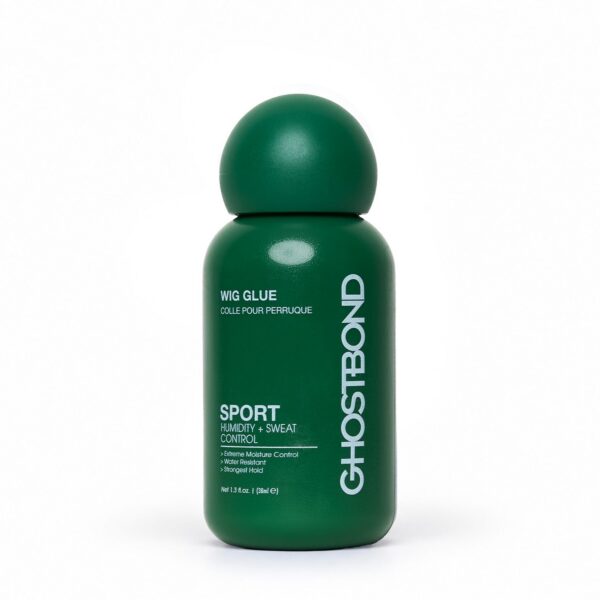
| Training and sport | GHOSTBOND Sport Wig Glue (formerly GHOSTBOND Platinum) | Strongest in the range. Sets water resistant |
| Hairline touch-ups and travel | GHOSTBOND LaceLock Ultra Precision Wig Glue (formerly GHOSTBOND One & Done) | 10ml tube, precision tip. Thin layer on the front hairline, wait until clear and tacky, press, secure with a lace melt band or towel until dry |
Hold times are as stated on each product page. Real wear depends on skin type, oiliness, climate and prep. Patch test every adhesive 24 hours before use, don’t use it on open skin wounds, and stop and ask a doctor if irritation or rash occurs. Patch test the Scalp Protector too.
How to apply GHOSTBOND wig glue to a lace or skin base
- Patch test. Test the adhesive and the Scalp Protector on the client’s skin 24 hours before the fitting.
- Prep the scalp. Apply a thin, even layer of GHOSTBOND Scalp Protector to clean, dry skin on the bonding area, and let it dry completely. It dries to a film the adhesive bonds to.
- Coat the base, for skin systems and wigs. On a skin / polyurethane system or a wig, apply a thin coat to the base of the system before the first coat on the scalp. For lace units, skip this step.
- Apply 4 thin coats to the scalp. Allow around 20 seconds between coats so each dries clear.
- Let the coats dry before attaching. Wait 7 to 10 minutes after the 4th coat before attaching the system.
The product pages warn that too much product and too little dry time is the most common cause of a hold that fails.
For removal, GHOSTBOND BondBreak Skin Friendly Glue Remover (formerly UltraSafe Adhesive Remover) goes on the adhesive line once the edge has been gently lifted, without pulling or forcing it. Leave it for 1 to 3 minutes before peeling the unit away. Patch test it before full use. It contains fragrance allergens, so don’t apply it to broken, irritated or inflamed skin. To clean the unit itself, GHOSTBOND BondGone Glue Remover (formerly GhostBuster Citrus Remover) is for units, not skin. Soak the buildup for 3 to 5 minutes, lift it with a soft cloth or brush, then wash the unit with shampoo and let it air dry fully. Both removers have the warning “Keep away from open flames or sources of ignition” (see our guide to flammable hair products).
Stocking wigs and hair system supplies
GHOSTBOND adhesives are made in Ireland by Professional Hair Labs and supplied to verified salons, stylists and wholesale partners. Classic, Endure, Motion, Daily and Sport come in 38ml (1.3oz) and 147ml (5oz) sizes. Browse the full GHOSTBOND catalogue or talk to our trade team about a professional account.
Products in this guide



FAQ
What are the different types of wigs?
The main types are named by cap construction: capless (wefted), monofilament, hand-tied, lace front, full lace and 360 lace, plus closure, frontal and U-part units. Each can be made in human hair or synthetic fibre. Hair systems are named by base instead: lace, polyurethane skin, monofilament or hybrid.
What are the types of wigs and their names?
By cap: capless or wefted, monofilament, double monofilament, hand-tied, lace front, full lace, 360 lace, closure, frontal, U-part, skin top and silk top. By fibre: human hair, Remy human hair, synthetic, heat-friendly synthetic and blends. One wig often has several of these names.
What types of wigs are there for men?
Men’s options include hair systems, also called toupees or hairpieces, which cover part of the head, and full wigs, which cover the whole head. Hair systems are built on a polyurethane skin, lace, monofilament or hybrid base and attached with tape, liquid adhesive or clips.
What’s the difference between a lace front and a full lace wig?
A lace front has lace only at the hairline, on an ordinary cap, while a full lace wig’s base is made entirely of lace. In between sits the 360 lace wig, with lace around the whole perimeter and cap in the middle.
What’s the difference between a 13×4 frontal and a 4×4 closure?
A 13×4 frontal is a lace strip of roughly 13 by 4 inches (about 33.0 by 10.2 cm) that runs ear to ear, so it can be parted anywhere along the front. A 4×4 closure is a 4 inch (10.2 cm) square of lace that allows a middle or side part. The frontal needs regular edge maintenance, and the closure is lower maintenance.
What is a Remy human hair wig?
Retailers use it for a wig made from human hair with the cuticles intact and aligned in one direction. We didn’t find a legal or standards definition of “Remy”, so ask the supplier how they source and sort the hair.
Which hair system base lasts longest?
In New Times Hair’s 2026 guide, monofilament lasts longest at around 6 to 12 months, and ultra-thin skin of 0.02 to 0.03 mm the shortest at around 3 to 6 weeks. Real lifespan depends on the base, thickness, hair, wear and maintenance.
Should a lace hair system be glued or taped?
Both are used. New Times Hair lists tape and liquid adhesive for lace. It cautions that liquid glue on a mesh base “is likely to seep through the base and cause damage to the hair”, and says most professionals tape mesh systems. GHOSTBOND wig glues list lace and skin systems and, for lace, put the coats on the scalp only. Their pages don’t make a claim about seep-through, so test on the unit first.
How are wigs attached without glue?
With clips, combs, built-in adjustable straps, an elastic band sewn inside the cap, or a wig grip band worn underneath. Some wigs and U-parts are sewn in by a stylist instead.
Sources and method
- Breastcancer.org, “What Type of Wig Cap Is Best for You?”, Carliz Sotelo Moore, updated 19 July 2022: breastcancer.org
- Breastcancer.org, “Synthetic vs Human Hair Wigs”, Carliz Sotelo Moore, updated 19 December 2023: breastcancer.org
- Headcovers, “Wig Buying Guide” (types of wigs): headcovers.com
- Simply Wigs, “Wig Cap Construction Explained”, March 2025, modified August 2025: simplywigs.co.uk
- Simply Wigs, “What Is Remy Hair and Why Do We Love It?”, November 2024, modified December 2025: simplywigs.co.uk
- Mayvenn, “Complete Guide to Lace Wigs”, updated September 2026: mayvenn.com
- Mayvenn, “Closure vs Frontal”, updated September 2026: mayvenn.com
- Behindthechair.com, “Wigs 101: U-Part, Lace Front, Closure”: behindthechair.com
- Hairalicious, “Silk top vs skin top wigs”, updated July 2026: hairalicious.com
- American Hair Loss Association, “Men’s Hair Pieces”, last modified September 2026: americanhairloss.org
- New Times Hair, “Popular base designs at New Times Hair”, Vivian Lv, 19 August 2026: newtimeshair.com
- New Times Hair, “Differences between net bases and skin bases”, January 2020: newtimeshair.com
- New Times Hair, “Introduction to wig base materials part 1”, October 2019: newtimeshair.com
- New Times Hair, “Hair system tape vs glue”, Alf Hou, April 2022: newtimeshair.com
- New Times Hair, “What is a toupee”, June 2026: newtimeshair.com
- Alopecia UK, “Introduction to alternative hair solutions for men”, Amy Johnson, updated January 2026: alopecia.org.uk
- Wig Studio 1, “What is the difference between Remy human hair and regular human hair”: wigstudio1.com
- Wigs.com, “How to style heat-friendly synthetic wigs”, July 2021: wigs.com
- Milk & Honey Wigs, “How to secure a wig without glue”: mhwigs.com.au
- Professional Hair Labs product pages for GHOSTBOND Classic, Endure, Motion, Daily, Sport and LaceLock wig glues, Scalp Protector, BondBreak and BondGone (live site, 2 October 2026)
About this guide
Written by Professional Hair Labs, the manufacturer behind GHOSTBOND, for the studios, stylists and barbers who fit wigs and hair systems. Last updated on 2 October 2026. Base and fibre figures are the published figures of the makers and organisations named, and real results vary. New Times Hair has published two different figures for Swiss lace: “less than four weeks” in 2019 and around 2 to 3 months in 2026. The base table uses the 2026 figure. Always follow the label and instructions for each product.